


After more than twenty years working on digital transformation projects, one thing still surprises me: we continue to invest considerable amounts of money to transform our organizations, yet we too often begin by choosing the technology.
I have seen organizations adopt “best-of-breed” solutions, hoping that processes and ways of working would naturally follow. Yet one fundamental question should come before any technology decision: what are we really trying to transform? Our information systems, or the way we work?
A digital transformation should start with the transformation we want to achieve. Technology should support that transformation, not define it.
When the Solution Comes Before the Problem
The approach is familiar. An organization wants to modernize its operations. It selects a powerful technology solution, sometimes a “best-of-breed” platform that already incorporates standard processes and best practices. The implementation then begins with the expectation that processes and the organization will adapt to the new platform.
The problem quickly becomes apparent: we are pushing a technology to address needs that have not been sufficiently defined, while sometimes having only a limited understanding of the current situation.
Technology therefore begins to dictate the transformation. We start with the solution and work backward toward the needs: a bottom-up approach.
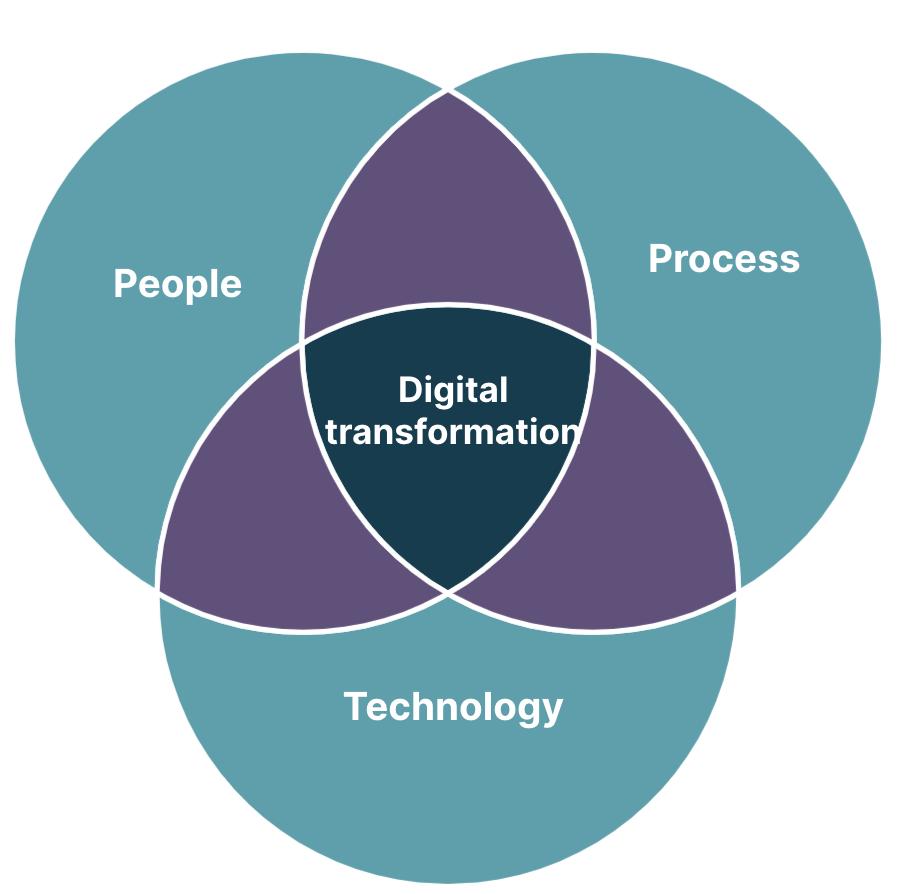
The approach should instead be top-down: understand the current state, define the target state, and then identify the gaps between the two. Those gaps determine the changes required across three dimensions: processes, organization and technology.
Technology then becomes a means of achieving the desired transformation, rather than determining what the organization itself needs to transform.
This may seem obvious when presented this way. And yet, many projects involving millions of dollars still begin with a technology solution as their starting point.
When the Cost of Poor Design Appears Too Late
This distinction is not simply a matter of methodology. It has direct consequences for project costs, timelines and risks.
When processes and organizational needs are not sufficiently defined at the outset, they do not disappear. They resurface later, when the solution is already being designed or configured.
At that point, organizations may have to redesign processes, revisit decisions, reconfigure the solution, rebuild integrations and deal with much greater resistance to change.
The cost is therefore not simply shifted in time: it can multiply because the correction comes too late.
As with any design effort, poor definition upstream leads to much more costly corrections downstream. Investing sufficiently in the design phase is therefore not an additional cost; it is a way of reducing uncertainty, risk and implementation costs.
A Perspective That Goes Beyond Field Experience
This perspective is also directly reflected in recent OECD research.
In its Digital Government Outlook 2026, the OECD makes the point very clearly:
“Technology alone does not transform government and its public services.”
The OECD explains that technology investments need to be accompanied by the capabilities and conditions required to produce meaningful results.
This directly reinforces the issue raised here: no matter how effective a technology may be, it does not constitute a transformation in itself. Transformation must affect the way an organization operates and the outcomes it seeks to achieve.
The OECD‘s Digital by design principle goes further by advocating the integration of digital thinking into the design of policies, processes and services from the outset, rather than adding technology onto existing structures.
What About Québec?
The Québec framework also raises an interesting question. Québec’s Act respecting the governance and management of the information resources of public bodies and government enterprises defines an information resources project around the development, acquisition, evolution or replacement of an information asset or information resource service.
It would nevertheless be unfair to suggest that the legislation ignores organizational transformation. It explicitly recognizes organizational transformation and provides for digital transformation planning.
The issue, therefore, is not whether organizational transformation is recognized. The question is whether, in practice, we give that transformation the place it deserves before selecting and configuring the technology that is supposed to support it.
Rethinking the Starting Point
What if we simply reversed the logic?
Before launching a major digital project, let us first define the transformation we are trying to achieve: Where are we today? Where do we want to go? And what gaps do we need to close?
Only then should we determine how processes, organization and technology can work together to deliver that transformation.
This approach would make it possible to better manage risks, make decisions more transparent, and, above all, prevent design problems from becoming implementation problems several years later.
Technology is a powerful lever for transformation.
But it should not drive the transformation. It should help us achieve the transformation we have clearly defined from the outset.