


General Introduction to OCPM
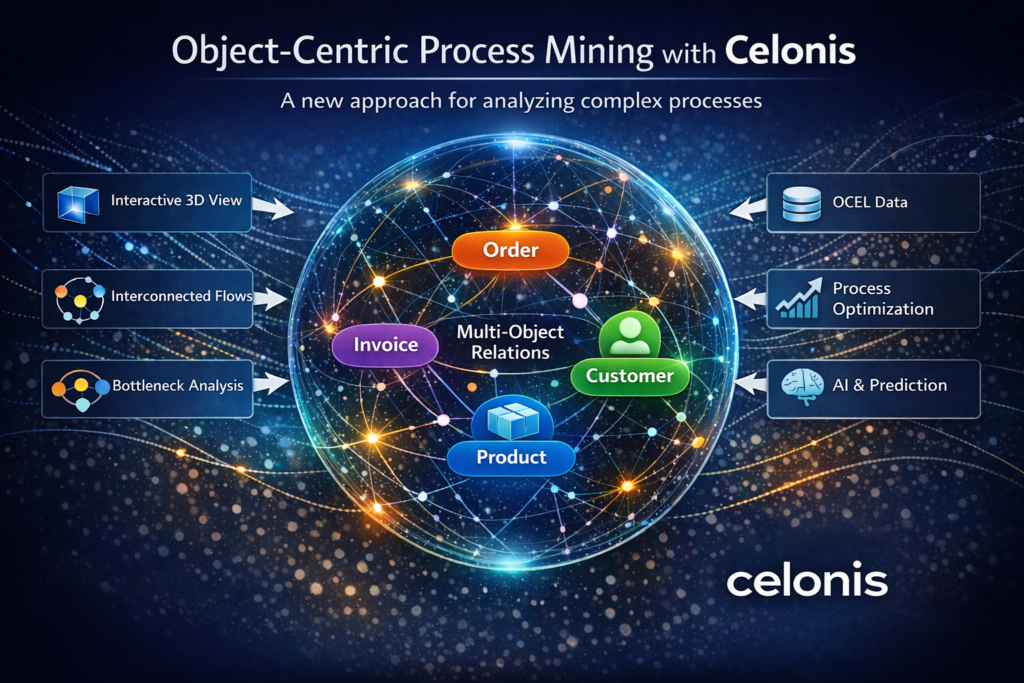
Object-Centric Process Mining (OCPM) is a modern process mining approach designed to better reflect the real complexity of operations. Unlike classic analysis centered on a single case, OCPM takes into account several interconnected objects, such as orders, products, and customers. This allows for a more faithful representation of processes. Technological players like Celonis have played a major role in the concrete implementation of this approach by integrating it into their process analysis platforms.
The Limitations of Traditional Process Mining
Classic process mining relies on event logs tied to a unique identifier (case ID), which works well for simple processes. However, in complex environments, this approach shows its limits. It fails to capture cross-relationships between multiple objects and does not allow for multi-dimensional analysis. Furthermore, each new analysis requires reconstructing a new log, which increases the burden on projects. In summary, this approach oversimplifies realities that are often much more nuanced.
The Emergence of the Object-Centric Approach
The object-centric approach was born to address these limitations. It proposes analyzing processes through the business objects themselves, capturing their natural interactions. This makes it possible to detect inefficiencies at the intersection of multiple flows, for example, between orders, deliveries, and invoices. This new way of modeling data reconciles complex management systems with more intuitive analysis. OCPM thus makes visible connections often ignored in traditional models.
Celonis’ Role in this Evolution
Celonis has been a true catalyst in the diffusion of OCPM. By integrating this approach into its platform through the Process Sphere feature, Celonis has allowed companies to explore their processes from a new angle. This innovation offers a more realistic representation of operations, where interactions between objects are fully visible. This paradigm shift makes it possible to identify systemic problems previously inaccessible, while facilitating collaboration between departments.
The Technical Foundations of OCPM
OCPM relies on an object-oriented event log, where each event can be linked to multiple objects. This requires a more complex data structure, with an event table containing references to the relevant objects, and an object table with their types and attributes. This model captures one-to-many and many-to-many relationships, allowing for a three-dimensional representation of processes. The result is a more nuanced analysis, better suited to the reality of large companies.
Typical Use Cases with Celonis
With Celonis, OCPM allows for the analysis of complex processes such as supply chain, order management, or invoicing. For example, it becomes possible to visualize the impacts of a product quality issue on deliveries and customer satisfaction. The multi-object approach makes it possible to identify inefficiencies related to coordination between departments. This helps companies make faster and more relevant decisions on improving their processes.
Advantages for Large Companies
OCPM provides large companies with better visibility into their operations. It helps avoid the duplication of data extractions, better understand dependencies between departments, and act on the root causes of inefficiencies. The multi-dimensional representation facilitates the identification of bottlenecks and flow disruptions. This results in gains in efficiency, cost reduction, and service quality.
Implementation Challenges
Implementing OCPM requires a good command of data and an adapted infrastructure. Multi-object event logs demand rigorous cleansing and precise modeling. In addition, tools must be capable of processing large volumes of interconnected data. Team training and data governance are essential to ensuring project success. However, the long-term benefits largely offset these initial efforts.
Comparison Between OCPM and the Classic Approach
Where the classic approach follows a single thread tied to one case, OCPM offers a network vision where each event can affect multiple objects. This difference transforms the way processes are understood. The classic model resembles a 2D map, whereas OCPM provides a 3D view. This depth allows for the identification of anomalies or dependencies previously ignored. OCPM is therefore establishing itself as a powerful complement, or even a more suitable alternative, to modern realities.
The Future of Process Mining with AI
The integration of AI with OCPM opens up new perspectives. Algorithms can detect complex patterns, predict delays, or recommend corrective actions. Real-time analysis becomes possible, facilitating a proactive response to problems. Combined with the richness of multi-object data, AI makes it possible to go beyond diagnosis to enter automatic optimization. This is a major evolution towards intelligent and adaptive process management.
Conclusion
Object-Centric Process Mining is reinventing the way processes are analyzed by taking into account the multi-object reality of businesses. By offering a richer and more precise vision, it allows for more relevant optimization of operations. Celonis has greatly contributed to making this approach accessible and effective. In combination with artificial intelligence, OCPM promises to bring a new generation of tools for performance management and fostering more agile continuous improvement.